What is a Composite Skill Lab (CSL)?
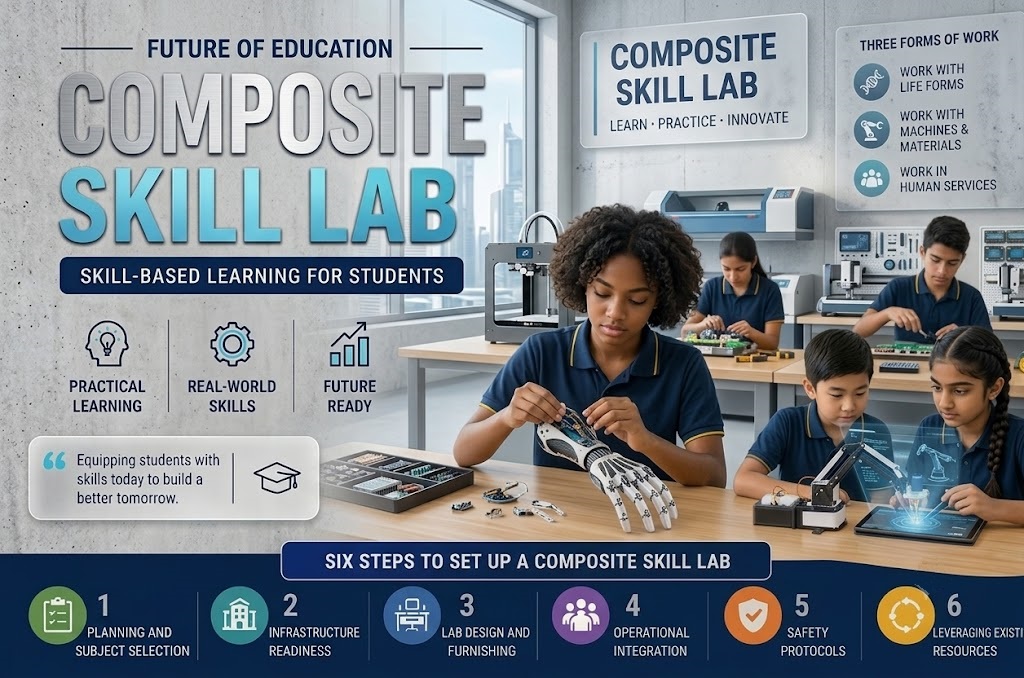
A Composite Skill Lab is a dedicated, multi-functional school space designed for hands-on, practical learning across various vocational subjects. Mandated by the CBSE for Grades VI to X, it shifts the educational paradigm from rote memorization to practical application.
Key Student Activities:
- Handling tools and machinery safely.
- Acquiring real-world, industry-relevant skills.
- Applying theoretical concepts to practical scenarios.

Why CSL is Critical for Modern Schools
The CSL bridges the gap between academic theory and real-world execution.
- Career Readiness: Prepares students for the modern workforce early on.
- Holistic Exposure: Introduces students to multiple vocations before higher education.
- Enhanced Engagement: Boosts student interest through interactive, project-based learning.
The 6-Step Guide to Setting Up a CSL
1. Planning and Subject Selection
Schools must align with CBSE guidelines and select vocational subjects relevant to local needs. The curriculum must cover three core sectors across 110 hours annually:
| Sector | Example Streams |
|---|---|
| Work with Life Forms | Agriculture, Organic Farming |
| Work with Machines & Materials | Electronics, Apparel, Textiles |
| Work in Human Services | Healthcare, Retail, Tourism |
2. Infrastructure Readiness
A compliant lab space requires proper physical and technical planning:
- Space: Minimum of 600 sq. ft. dedicated area.
- Power: Robust electrical setup with both 5-amp and 15-amp sockets.
- Environment: Proper ventilation, optimal lighting, and safety-grade flooring.
- Tech Integration: Digital infrastructure capable of supporting AI-based learning.
3. Lab Design and Furnishing
The layout must be dynamic and adaptable to different vocational tasks:
- Modular workstations and easily movable benches.
- Organized storage systems and visible tool display boards.
- Audio-visual aids like projectors or LED screens for demonstrations.
4. Operational Integration
To make the lab effective, integrate it into daily school operations:
- Embed dedicated skill education slots into the school timetable.
- Focus heavily on project-based learning and regular practical assessments.
- Upskill and train teachers for specialized vocational instruction.
- Host Kaushal Melas (Skill Exhibitions) to showcase student projects.
5. Safety Protocols
Because students handle tools and machinery, safety is paramount:
- Equip the room with fire extinguishers and comprehensive first-aid kits.
- Display safety instructions and tool labels clearly at every station.
- Conduct regular emergency drills for students and staff.
6. Leveraging Existing Resources
Schools can optimize budgets by cross-utilizing current infrastructure:
- Use existing IT labs for digital and AI skills.
- Incorporate Atal Tinkering Labs (ATL) or existing Makerspaces into the CSL ecosystem.
The Bottom Line
Under NEP 2020, implementing a Composite Skill Lab is no longer an optional luxury—it is a regulatory necessity. It transforms schools from centers of memorization into hubs of innovation, ensuring students are truly future-ready.
Are you looking to set up a compliant Composite Skill Lab for your school, or do you need help aligning your existing infrastructure (like an ATL or IT Lab) with the new CBSE guidelines?
Leave A Message


Comments