The Future of Education: Why Every School Needs a Composite Skill Lab (CSL)
The future of education is changing rapidly. Traditional classrooms are no longer enough to prepare students for real-world challenges. Today, schools must focus on skill-based learning, and this is where the Composite Skill Lab (CSL) plays a crucial role.
Under the National Education Policy (NEP) 2020, CBSE has made it mandatory for schools to establish a Composite Skill Lab to integrate vocational education from Grades VI to X.
This is not just an upgrade—it is a transformation from theory-based learning to practical, skill-driven education.
What is a Composite Skill Lab?
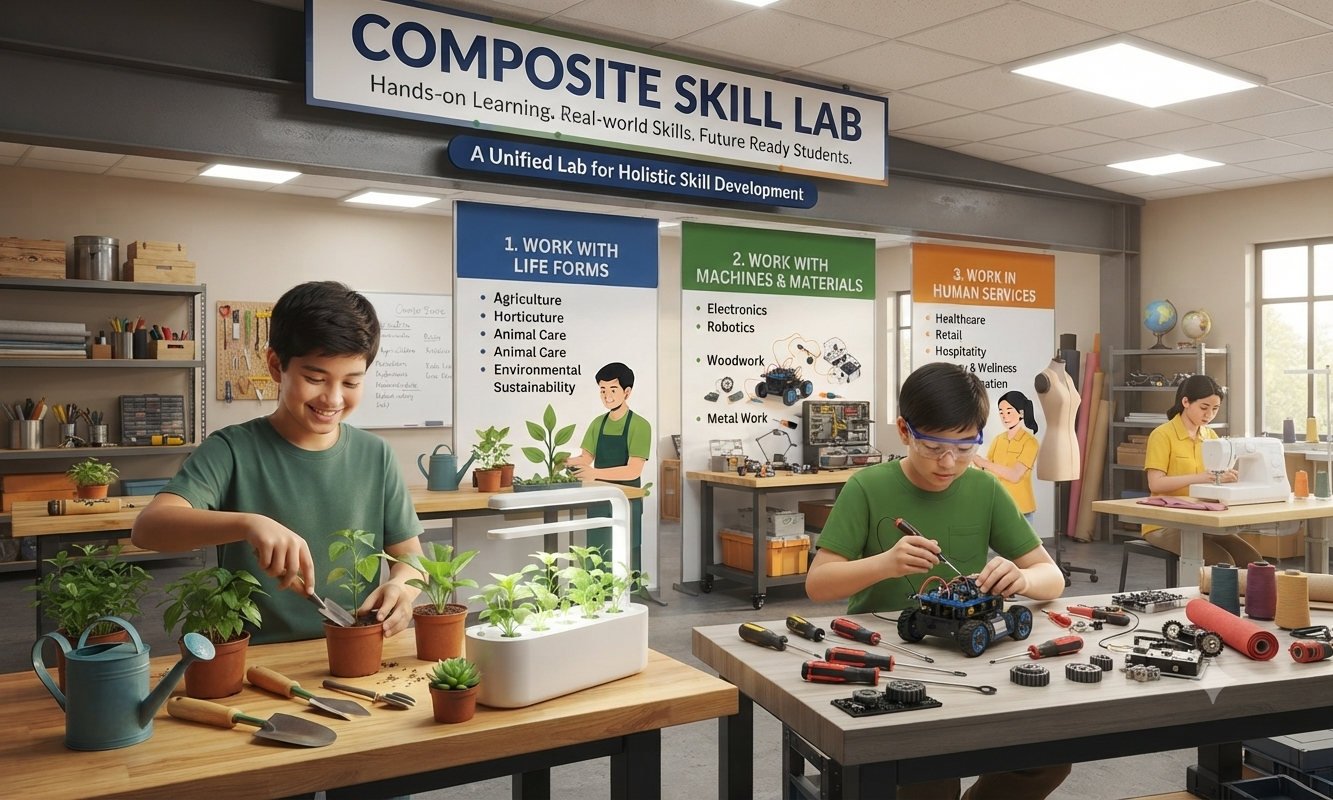
A Composite Skill Lab is a dedicated space in schools designed for hands-on, practical learning across multiple vocational subjects. It allows students to:
- Work with tools and machines
- Learn real-world skills
- Apply concepts practically
Unlike traditional classrooms, a Composite Skill Lab focuses entirely on learning by doing.
Why a Composite Skill Lab is Important in Schools
The introduction of the CSL bridges the gap between academic knowledge and real-world application. Key benefits include:
- Development of practical, hands-on skills
- Improved problem-solving abilities
- Better career readiness from an early age
- Broad exposure to multiple vocations
- Increased student engagement and enthusiasm
It ensures that students don’t just learn—they apply.
Six-Step Guide to Setting Up a Composite Skill Lab
1. Planning and Subject Selection
To successfully implement a Composite Skill Lab, schools must:
- Follow CBSE guidelines for CSL setup
- Select skill subjects based on local needs and student interest
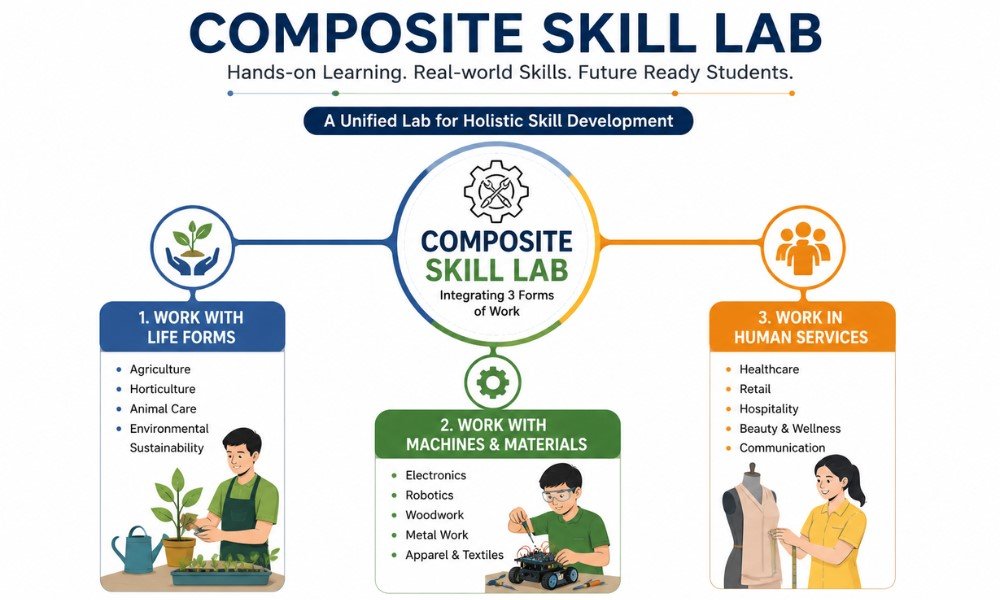
- Cover three key vocational areas:
- Work with Life Forms: Agriculture
- Work with Machines & Materials: Electronics, Apparel
- Work with Human Services: Healthcare, Retail
Note: Students must complete 110 hours of skill education annually, making the CSL a core part of the curriculum.
2. Infrastructure Readiness
A well-equipped Composite Skill Lab requires:
- Minimum 600 sq. ft. of dedicated space
- Proper electrical fittings (5-amp & 15-amp sockets)
- Adequate ventilation, lighting, and safety flooring
- Digital setup for modern, AI-based learning
A strong infrastructure ensures safe and effective skill-based education.
3. Lab Design and Furnishing
The design of a Composite Skill Lab should be flexible and practical:
- Modular workstations
- Movable benches
- Organized storage systems
- Tool display boards
- Projectors or LED screens for visual learning
This makes the lab dynamic and adaptable for diverse classroom activities.
4. Operational Integration
A Composite Skill Lab must be fully integrated into daily school operations:
- Include skill education prominently in the timetable
- Implement project-based learning methodologies
- Conduct regular formative and summative assessments
- Train teachers continuously for skill-based pedagogy
- Build partnerships with local industries and experts
Schools can also organize a Kaushal Mela (Skill Exhibition) to showcase student learning to parents and the community.
5. Safety Protocols
Safety is paramount in a hands-on learning environment. Schools must ensure:
- Readily available fire extinguishers and first-aid kits
- Safety instructions displayed clearly on walls
- Proper, color-coded labeling of all tools
- Regular emergency drills and safety training
A safe environment ensures confident, worry-free learning.
6. Leveraging Existing Resources
Schools can optimize their current infrastructure to cut costs:
- Use existing IT labs for digital skills
- Utilize Atal Tinkering Labs (ATL) if available
- Convert standard makerspaces into a CSL
However, dedicated compliance with CBSE guidelines remains necessary for a proper setup.
How the Composite Skill Lab Transforms Education
The Composite Skill Lab is not just about vocational training—it is about preparing students for life. Through CSL, students gain:
- Practical exposure
- Unshakable confidence
- Technical literacy
- Real-world understanding
Conclusion
The Composite Skill Lab is a major milestone toward future-ready education. By seamlessly combining academics with practical skills, schools can create confident, capable, and career-ready students.
With NEP 2020 and CBSE guidelines in place, adopting a Composite Skill Lab is no longer optional—it is essential. Because the future belongs to those who can create, apply, and innovate, not just memorize.
Planning to implement a Composite Skill Lab in your school?
Our team at Auxilium Innovators helps schools with complete setup, compliance, and execution.
GET IN TOUCH
- Contact: +91 8109139005
- Email: info@auxiliuminnovators.com